




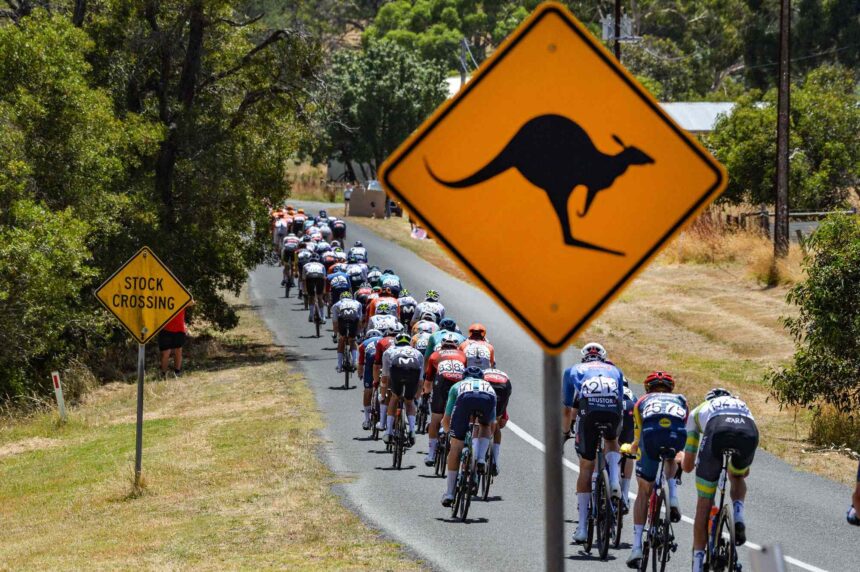
The Tour Down Under is meant to be a celebration of speed, endurance, and the wide-open roads of South Australia. On Sunday, it became something else entirely.
Midway through the race’s final stage, the world’s best cyclists were suddenly reminded that these roads don’t belong to them alone.
What unfolded was unexpected, unsettling, and very Australian.
A Sudden Interruption on the Open Road
About 45 miles into the 105-mile stage in Adelaide, two large kangaroos leapt onto the race course without warning.
Riders moving at high speed had no time to react. Several were struck and knocked from their bikes as the animals cut directly through the peloton.
The incident was broadcast live, leaving commentators momentarily stunned as the chaos unfolded in real time.

Riders Down, Race Changed
Among those caught in the collision was Jay Vine, the Australian cyclist who would later win the stage and the overall race.
Other riders involved included Menno Huising, Lucas Stevenson, Mikkel Bjerg, Juan Molano, and Alberto Dainese. Several were forced to abandon the race entirely after the crash.
Local reports confirmed that none of the cyclists suffered serious injuries, a relief given the speed and force involved.
An Unavoidable Risk of Racing in Australia
One of the kangaroos was badly injured and later euthanized, adding a somber note to the spectacle.


For riders and organizers, the incident underscored a known but difficult reality. Much of the Tour Down Under passes through open or semi-rural areas where wildlife moves freely.
Unlike closed circuits or stadium sports, road racing unfolds in living landscapes. Fences, marshals, and planning can reduce risks, but they can’t eliminate them entirely.
Jay Vine’s Long Ride Back
After being knocked off his bike, Vine remounted, changed bikes twice, and rejoined the race with miles still ahead of him.
He went on to secure the win, claiming his second Tour Down Under title in three years.
The victory was hard-earned, marked as much by resilience as by athletic dominance.
Why the Moment Resonated
For viewers around the world, the images were startling. For Australians, they felt familiar.
Kangaroos are a daily hazard on country roads, especially at dawn and dusk. Drivers know the risk well. Cyclists, moving faster and more exposed, face it even more acutely.
The incident became a reminder that elite sport doesn’t happen in a vacuum. It unfolds alongside nature, unpredictability, and sometimes real loss.
A Quiet End to a Loud Moment
By the time the race concluded, order had returned. Jerseys were awarded. Cameras moved on.
But the moment lingered — a rare collision between global sport and local reality, captured in a few chaotic seconds.
It was a reminder that even the most carefully planned events can be reshaped by forces no one controls.
The incident sparked a wave of online reactions, blending shock, dark humor, and sympathy — not just for the riders, but for the animals involved.
It highlighted a broader tension familiar in many countries: how modern sport and infrastructure intersect with wildlife habitats. As races push into scenic, open spaces, moments like this reveal the hidden costs and compromises of sharing land with nature.
In this case, no rider was seriously hurt. But the collision left a lasting impression — a reminder that even at the highest level of sport, the unexpected is always part of the race.