





In a quiet Tucson neighborhood, uncertainty has settled in where routine once lived. Nearly two weeks after Nancy Guthrie vanished from her home, investigators say they still believe she may be alive — a fragile thread of hope guiding an increasingly complex search.
The case has drawn national attention not only because of its unsettling details, but because Nancy is the mother of Today show co-host Savannah Guthrie. What began as a local missing-person investigation has grown into a multi-agency effort filled with public appeals, forensic questions, and a family waiting for answers.
Authorities say the investigation remains active and urgent.
A Disappearance That Broke Routine
Nancy Guthrie was last seen on the evening of Jan. 31. Concern grew the next morning when she failed to join friends for a scheduled church livestream gathering — something loved ones say was out of character.
Investigators now believe she was kidnapped from her Tucson home in the early hours of Feb. 1.
Soon after, law enforcement confirmed troubling evidence: blood discovered on the exterior porch matched Nancy’s DNA, suggesting violence may have occurred at or near the home.

Despite that discovery, officials emphasize they are operating under the belief that she is still alive.
A Search Expands — and Questions Follow
The investigation involves both local authorities and federal agents, including the FBI. Searches have been conducted at Nancy’s residence and at the home of her daughter, Annie Guthrie, as detectives work to reconstruct events leading up to the disappearance.
Authorities have also requested footage from nearby Ring doorbell cameras, including recordings dating back nearly three weeks before the suspected abduction. Investigators are examining reports of a suspicious vehicle seen in the neighborhood during that period.
Meanwhile, multiple alleged ransom notes sent to local media outlets added another layer of uncertainty. Deadlines mentioned in those messages — Feb. 5 and Feb. 9 — passed without confirmed communication between the suspected kidnappers and the family.


Surveillance Footage Offers a Glimpse
One of the most significant developments came when the FBI released surveillance footage showing a masked individual tampering with a doorbell camera at Nancy’s front door.
Authorities describe the suspect as a man approximately 5 feet 9 inches to 5 feet 10 inches tall with an average build. He was seen carrying a black 25-liter Ozark Trail Hiker Pack backpack and appeared to be armed.
After the footage was released, Savannah Guthrie shared it publicly, writing that someone, somewhere, might recognize the person captured on camera.
Her message reflected a family’s reliance on strangers — neighbors, viewers, and online communities — to help fill in the missing pieces.
Dispute Over Evidence Testing
As the search continues, scrutiny has also turned toward how key evidence is being analyzed.
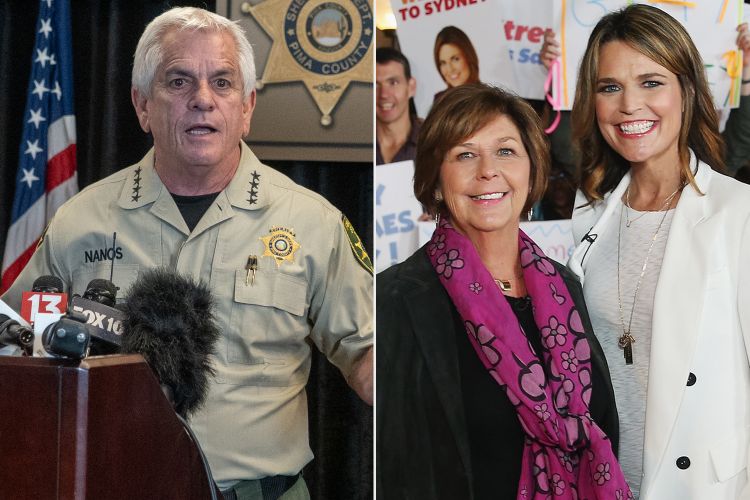
A Reuters report suggested that Pima County Sheriff Chris Nanos declined to send certain items — including gloves recovered near the scene — to the FBI’s forensic laboratory in Quantico, Virginia.
Nanos disputed that characterization in a local television interview, saying the FBI agreed with the decision to send all collected items to a private laboratory in Florida where broader DNA databases could be compared at once. He added that investigators are still unsure how significant the gloves may ultimately prove.
The disagreement has highlighted the intense pressure surrounding high-profile investigations, where every procedural decision can become part of the public conversation.
A Race Against Time
Investigators say Nancy Guthrie faces additional risks because she has limited mobility and requires daily medication she has not had access to since her disappearance.
That reality has sharpened the urgency behind search efforts.
The FBI is now offering a $100,000 reward for information leading to her recovery or to an arrest — a signal that authorities believe public tips could prove decisive.
Why This Case Resonates
Kidnapping cases often feel distant until they intersect with familiar faces or ordinary routines. Nancy Guthrie’s disappearance touches on universal fears: a home no longer feeling safe, a missed appointment turning into alarm, a family suddenly relying on hope and public goodwill.
For many viewers who know Savannah Guthrie as a steady presence on morning television, the story collapses the distance between public life and private vulnerability.
Behind headlines and investigative updates is a quieter reality — a family waiting for news, holding onto the possibility that someone, somewhere, knows something that could bring Nancy home.
And for now, that possibility remains the center of the search.