






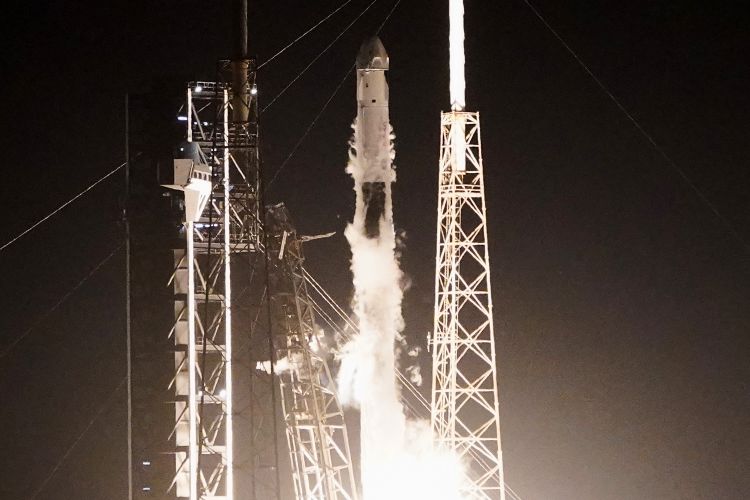
Before sunrise on Florida’s Space Coast, a rocket cut through the early morning sky — carrying not just astronauts, but a sense of normal rhythm returning to life aboard the International Space Station.
The SpaceX Crew-12 mission lifted off at 5:15 a.m. on Feb. 13 from Cape Canaveral Space Force Station, sending four international crew members toward orbit. If all goes as planned, they will dock with the station the following afternoon, bringing the orbiting laboratory back to full staffing after an unexpected disruption earlier this year.
For NASA and its global partners, the launch marks both continuity and recovery — a reminder that even in space, plans sometimes change.
A Multinational Crew Bound for Orbit
On board are NASA astronauts Jessica Meir and Jack Hathaway, joined by European Space Agency astronaut Sophie Adenot and Russian cosmonaut Andrey Fedyaev.
Their journey reflects the long-standing international collaboration that defines the International Space Station, where astronauts from different nations live and work together hundreds of kilometers above Earth.

Once docked, the crew will join Expedition 74 members already aboard the station: NASA astronaut Chris Williams and Roscosmos cosmonauts Sergey Kud-Sverchkov and Sergei Mikaev.
Together, they will restore the station’s typical seven-person crew — a number carefully calibrated to balance scientific work, maintenance, and daily operations.
Why This Launch Came Sooner Than Planned
Crew-12 was originally scheduled to launch later in February. But NASA accelerated the timeline after an unusual situation left the station understaffed.


Last month, the Crew-11 mission returned to Earth about a month early due to a medical concern involving one astronaut — the first time an ISS mission has been cut short for such a reason. Officials said the astronaut remained in stable condition, though specific details were not publicly disclosed.
With fewer hands aboard, routine research schedules and maintenance tasks became harder to sustain, prompting NASA to move quickly to replenish the crew.
Weather delays on Feb. 11 and Feb. 12 briefly postponed the launch, underscoring how even carefully planned missions remain at the mercy of Earth’s atmosphere before reaching space.
Science That Reaches Beyond Orbit
Once settled, Crew-12 will begin conducting experiments designed to support future deep-space missions while also delivering benefits closer to home.
Research aboard the ISS often focuses on medicine, materials science, and technologies that behave differently in microgravity — insights that can influence healthcare treatments, manufacturing processes, and environmental monitoring on Earth.
NASA leadership says these missions also help prepare humanity’s next steps beyond low Earth orbit, including planned journeys to the Moon and eventually Mars.
Life Aboard a Fully Staffed Station
The International Space Station operates much like a small, floating research campus. Every crew member plays multiple roles — scientist, engineer, technician, and sometimes even plumber.
When staffing drops below normal levels, astronauts must prioritize essential operations, leaving less time for experiments that require multiple participants or long observation periods.
Restoring a full crew means research timelines can resume, maintenance workloads can be shared more evenly, and astronauts regain something closer to a sustainable daily routine.
Why This Moment Matters on Earth
Space missions often appear distant from everyday life, yet they rely on deeply human systems: teamwork, trust, and adaptability when things don’t go as expected.
The early return of Crew-11 was a reminder that human spaceflight still carries risk despite decades of experience. The swift launch of Crew-12 shows how international agencies respond — not with drama, but with careful coordination and steady problem-solving.
For many observers, the story is less about rockets than resilience — how complex global efforts continue moving forward even after setbacks.
A Quiet Return to Normal
As Crew-12 approaches the station, the transition may feel routine to mission controllers. But routine in space is something earned, not assumed.
Hundreds of miles above Earth, a small group of people will soon share meals, conduct experiments, and watch continents drift silently below them — continuing a collaboration that has endured political shifts, technical challenges, and the unpredictability of human life itself.
Sometimes progress looks like a giant leap. Other times, it looks like simply getting everyone back where they belong.