






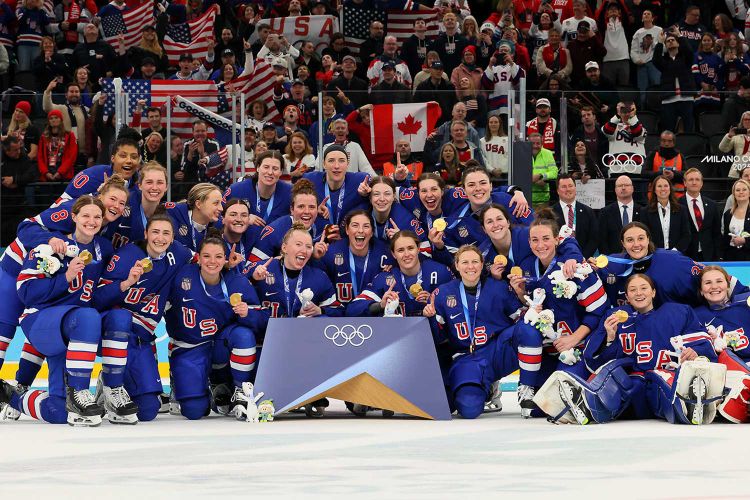
For the U.S. women’s hockey team, the 2026 Winter Olympics ended not with a political moment, but with a return to everyday life.
Fresh off a dramatic gold-medal victory in Italy, the players were invited to attend President Donald Trump’s State of the Union address — a traditional honor extended to championship teams. Instead, the athletes politely declined, choosing to head home and resume commitments waiting beyond the Olympic spotlight.
The decision came after a historic stretch for American hockey, one defined less by controversy than by achievement, milestones, and personal moments that unfolded alongside the games themselves.
A golden week for U.S. hockey
At the 2026 Winter Olympics, both U.S. hockey programs reached rare heights.
The women’s team captured gold on Feb. 19 with a tense 2–1 overtime win against longtime rival Canada. The victory marked their first Olympic championship since 2018, following a silver-medal finish four years earlier.
Just days later, the U.S. men’s team repeated the scoreline — another 2–1 win over Canada — earning its first Olympic gold medal since the famed 1980 triumph.

Together, the wins created one of the most successful Olympic hockey runs in modern U.S. history.
A White House invitation — and a polite no
After the men’s victory, President Donald Trump congratulated players during a phone call and invited both teams to attend his State of the Union address at the U.S. Capitol.
According to a statement shared by USA Hockey with NBC News, the women’s team expressed gratitude for the recognition but declined due to prior academic and professional commitments scheduled after the Games.
The response emphasized appreciation rather than protest — a practical decision reflecting how quickly Olympic athletes often transition back to school, training, and careers once competition ends.



Hilary Knight’s defining moment — on and off the ice
The championship hinged on a decisive goal from team captain Hilary Knight, who secured her second Olympic gold medal and fifth overall Olympic podium finish.
For Knight, 36, the Games also brought a deeply personal milestone. During the Olympic stay in Italy, she proposed to fellow U.S. Olympian Brittany Bowe, turning a career highlight into a life-changing trip in more ways than one.
Moments like these often pass quietly alongside medal counts — reminders that Olympic stories unfold far beyond the scoreboard.
A historic step for representation
The tournament also marked a breakthrough for inclusion in the sport.
Forward Laila Edwards became the first Black woman to compete for the U.S. women’s Olympic hockey team. Ahead of the Games, she spoke about the importance of visibility and the hope that young athletes might see new possibilities reflected in her journey.
Her presence signaled gradual change in a sport long viewed as lacking diversity, adding broader cultural meaning to the team’s success.
Why the moment resonated
Olympic victories often lead to ceremonial appearances and celebrations, but athletes’ schedules rarely pause for long. Many return immediately to university programs, professional leagues, or training cycles aimed at the next competition.
The women’s team’s decision highlighted that reality — a reminder that even gold medalists must quickly shift from global recognition back to ordinary responsibilities.
In the end, the story of this Olympic run may be less about a declined invitation and more about balance: between national pride and personal commitments, public recognition and private lives.
As the players dispersed after their victory, the medals came with memories of overtime goals, historic firsts, and quiet personal milestones — the kinds of moments that linger long after the closing ceremony fades.