






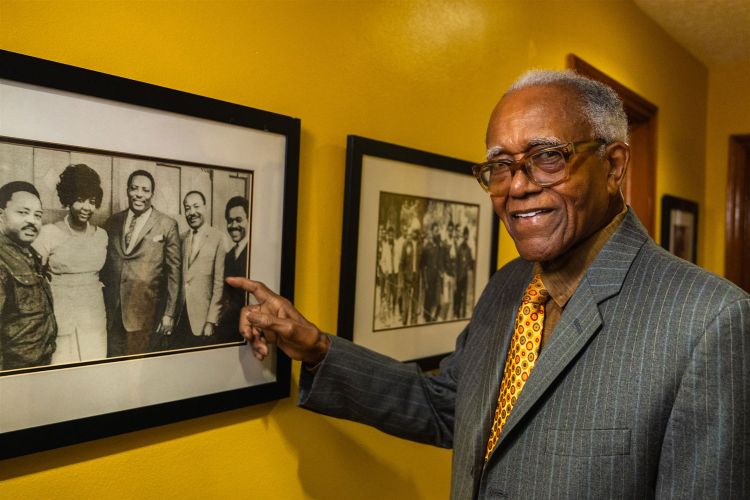
For most of his life, J.T. Johnson stood on the front lines of history — marching, organizing, and risking arrest alongside some of the most recognizable figures of the Civil Rights Movement. Few people around him knew he carried a deeply personal struggle at the same time.
Johnson, now 88, has revealed that he spent decades unable to read, living with undiagnosed dyslexia while helping reshape American society.
Today, more than half a century after marching beside Martin Luther King Jr., he is beginning a very different journey: learning to read for the first time.
A Hidden Challenge Behind Public Courage
Johnson was born in 1937 in Montezuma, Georgia, where school quickly became a source of confusion and embarrassment. He repeated second grade after struggling to learn basic reading skills but never received an explanation for why learning felt harder for him than for others.
Instead, he learned to adapt.
As a gifted athlete in football, basketball, baseball, and track, Johnson advanced through school largely because of his performance in sports. He relied on listening closely, memorizing information, and leaning on classmates and girlfriends to help him navigate assignments.

He graduated high school two years behind schedule — still unable to read comfortably — and quietly turned down opportunities, including pursuing a football scholarship, because he feared he could not manage college academics.
The struggle remained a secret, even from those closest to him.
Joining the Fight for Civil Rights
In 1962, after watching news coverage of protests unfolding in his hometown, Johnson felt called to return south and join the movement for racial justice.
He soon became part of King’s trusted organizing teams, helping coordinate demonstrations across the segregated South. Arrests became common, but so did momentum.



One of the most defining moments came in 1964 in St. Augustine, Florida, when Johnson helped lead protesters into a segregated motel swimming pool. The motel owner responded by pouring acid into the water in an attempt to force them out — images that spread worldwide and intensified pressure for federal civil rights legislation.
Despite regularly handling logistics and organizing meetings, Johnson found ways to avoid situations that required reading documents aloud. The movement’s urgency, he said later, left little space to confront his own struggle.
Building a Life While Carrying a Secret
After King’s assassination in 1968, Johnson continued civil rights work while building a career in Atlanta, raising a family, and starting a consulting business.
Colleagues helped with reports and written materials, often without realizing why he needed assistance. Dyslexia was rarely discussed or understood during those decades, and shame kept Johnson from explaining his difficulties — even to his children.
He occasionally tried adult literacy classes, but none addressed the underlying issue. Without knowing the cause, progress felt impossible.
A New Possibility Through Artificial Intelligence
Everything changed in December 2024 when Johnson watched a television segment about an artificial intelligence program called Dysolve, developed by clinical linguist Dr. Coral Hoh.
The software approaches dyslexia differently from traditional reading lessons. Rather than starting with words on a page, it analyzes how an individual processes language sounds and builds personalized exercises to retrain the brain’s pathways.
Curious and hopeful, Johnson contacted the program and began training sessions several times a week.
While he is not yet reading independently, he has already noticed improvements in spelling and recognizing how sounds form words — foundational skills many people develop in early childhood.
Researchers say the technology has shown promising results in children but remains largely untested in older adults, making Johnson an unexpected pioneer.
Why This Moment Matters
Johnson’s story reflects how learning disabilities were often misunderstood or overlooked for much of the 20th century. Many adults grew up without diagnoses, carrying private struggles that shaped education, careers, and self-confidence.
Today, increased awareness of dyslexia — believed to affect roughly one in five Americans — is changing how educators and technologists approach learning differences.
Artificial intelligence tools like Dysolve represent a new frontier, suggesting that learning may not have an expiration date.
For Johnson, the goal is deeply personal. The first book he hopes to read on his own is the Bible — something he has waited nearly nine decades to experience independently.
A Different Kind of March
Johnson says he wishes he had discovered help earlier in life. Still, he views this chapter not as regret, but as another step forward.
The man who once marched for equal rights now spends hours each week practicing sounds and letters, approaching progress with the same determination that once carried him through protests and jail cells.
History remembers his public victories. But this quieter one — learning to read at 88 — may be the most personal triumph of all.