






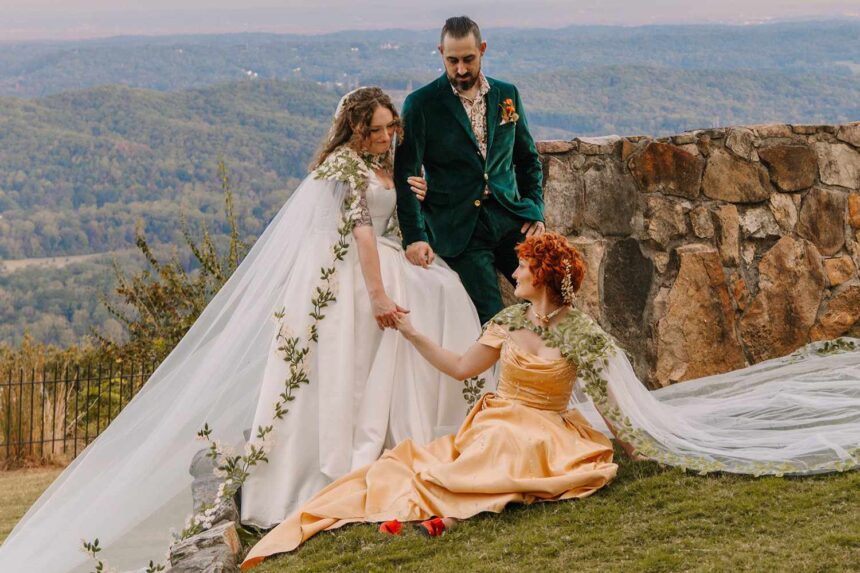
When Margaret French started planning her wedding, she quickly realized something fundamental wouldn’t fit.
Most wedding traditions are designed for two people. Her family, however, was made up of three.
The result was a ceremony that looked different from most — not to make a statement, but to reflect the life they were already living together.
From a Tinder Match to a Family of Three
Margaret met Cody on Tinder years ago, expecting nothing more than a casual connection.
Neither was looking for a long-term relationship. But they clicked, kept spending time together, and slowly built something more serious.
Margaret had previous experience with non-monogamy. Cody, raised in a more conservative environment, did not. Still, after many conversations, they agreed to open their relationship and explore it together.
Related News

When Janie Changed Everything
Meeting Janie marked a turning point.
What began gradually — shared time, shared routines, shared affection — eventually became unmistakable. The three found themselves functioning less like a couple plus one, and more like a unit.
Janie moved in. “I love you” was said. A family formed, quietly and deliberately.
Nearly a decade later, that bond was still intact.



Why the Wedding Was Symbolic — and Still Important
Margaret and Cody had already legally married early in their relationship, around the time Janie entered their lives.
But the trio wanted something more public and intentional: a chance to stand in front of the people they love and say, this is real, and this is our family.
The ceremony wasn’t legally binding. It didn’t need to be.
What mattered was recognition — from friends, from chosen family, and from themselves.
Rethinking Traditions, One Choice at a Time
Planning a wedding for three required creativity.
They reconsidered everything, from walking down the aisle to where the officiant would stand. Cody walked first. Janie followed — it was her first wedding. Margaret came last, escorted by her father.
Their clothing reflected that individuality, too. Janie wore white. Margaret chose marigold.
There were no bridal parties. No sides. No forced symmetry.
“It just didn’t make sense,” Margaret explained, noting how easily traditional roles fall apart when love doesn’t follow a standard shape.
Support, Absence, and What Still Showed Up
Not everyone attended.
Some of Janie’s relatives stayed away due to religious beliefs. Others stepped in — Margaret’s mother and Cody’s father walked Janie down the aisle together.
Friends and family mingled without tension. No awkward scenes. No drama.
The day, by all accounts, unfolded calmly and joyfully.
Why This Story Resonates
This wasn’t about spectacle or pushing boundaries for attention.
It was about adapting a deeply familiar ritual to fit a life that already worked — one built on communication, patience, and time.
For many readers, the story taps into a broader shift: people reshaping traditions to reflect who they actually are, rather than who they’re expected to be.
A Quiet Celebration of What Worked
At the end of the day, Margaret remembers the ordinary details.
Good weather. Easy conversations. Everyone behaving themselves.
Seeing people from different parts of their lives come together, simply celebrating the fact that three people had made a relationship work for ten years — that was the moment that stayed with her.
Not perfect. Just real.