






It started as a quiet day outdoors — the kind many families know well.
An 11-year-old boy, a pair of grandparents, and miles of open land in southwest Wyoming.
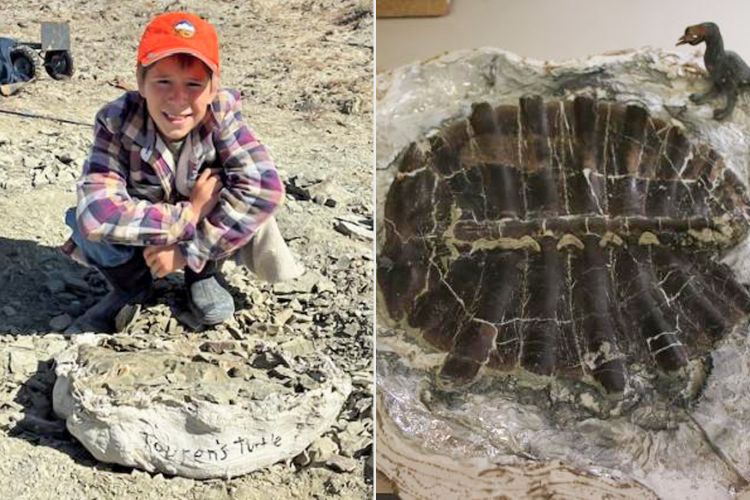
By the end of it, Touren Pope had stumbled upon something that had been waiting nearly 48 million years to be seen again.
A Curious Find in the Desert
Last year, Touren was exploring Bureau of Land Management (BLM) land in the Greater Green River Basin with his grandparents, Patti and Tom Patterson.
They were simply looking for interesting rocks.
Instead, Touren noticed something unusual — pale, fragile, shell-like shapes embedded in the ground. Some were broken. Some were intact. Curious and a little bored, he kept digging.
Related News

What he uncovered turned out to be a nearly complete fossilized soft-shelled turtle.
A Landscape That Once Held a Lake
Today, the area is dry and windswept.
But 48 million years ago, it looked very different.
The region was once part of a lush tropical floodplain surrounding Lake Gosiute. Fish, crocodiles, and turtles thrived there in warm, shallow waters.


The fossil Touren found had rested in that ancient lakebed ever since.
According to BLM officials, the turtle shell was remarkably well preserved — almost entirely intact.
Museum specialist J.P. Cavigelli, part of the excavation team from the Rock Springs Field Office, said it was clear almost immediately that the discovery was significant.
The turtle was identified as a soft-shelled species — a group that still exists today. In fact, experts say if you could travel back in time, you’d likely recognize it.
Doing the Right Thing
Touren’s grandparents sensed this wasn’t an ordinary find.
They sent a photo to his mother, Tessa Patterson, an amateur geologist. She was stunned.
The family then followed the proper steps, reporting the discovery to the BLM instead of attempting to remove it themselves.
That decision mattered.
Fossils exposed at the surface can deteriorate quickly. According to archaeologist Craig Thomas, the specimen was found just in time before natural elements could damage it beyond repair.
BLM staff organized a formal excavation — and Touren was invited to help.
As a small but meaningful reward, he was allowed to name the turtle.
He chose “Little Timmy.”
Why It Matters
Wyoming is known for its deep fossil history, but discoveries like this don’t only belong to scientists.
They often begin with ordinary people paying attention.
Public lands across the United States hold scientific treasures, but they rely on responsible visitors to protect them. By reporting the fossil instead of keeping it, Touren helped preserve a piece of natural history for study and education.
For a child who simply set out to collect rocks, it became something much bigger — a lesson in curiosity, patience, and stewardship.
And somewhere beneath Wyoming’s wide skies, a long-buried turtle finally saw daylight again.