






For the 55 people on board a Starsky Aviation flight this week, what began as a routine journey quickly turned into a tense return to the runway.
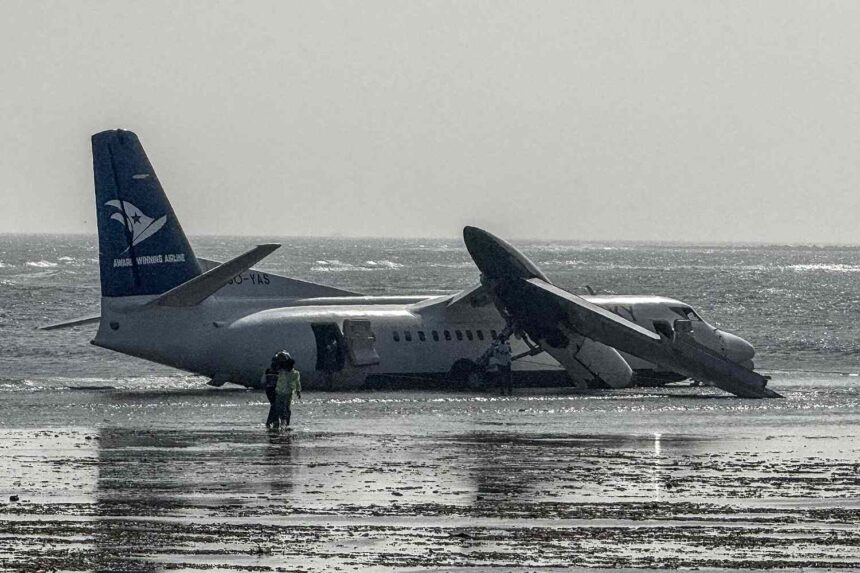
Just 15 minutes after takeoff on Feb. 10, the crew detected a mechanical problem. The decision was made to turn back to Mogadishu. Minutes later, the aircraft would end up in shallow ocean waters just beyond the airport runway.
And remarkably, everyone survived.
A Sudden Change in the Air
The aircraft had departed from Mogadishu’s Aden Abdulle International Airport earlier that afternoon.
At around 1:17 p.m. local time, as it attempted an emergency landing, the plane overran the runway and slid into the sea, according to Somalia’s Civil Aviation Authority.
Images shared by the African Union Support and Stabilization Mission in Somalia show the aircraft resting in calm, shallow water — responders standing nearby, the shoreline not far off.
Related News

It could have been far worse.
Confusion, Then Relief
Initial statements from regional authorities suggested some passengers had been injured.
But later, Starsky Aviation’s CEO told the Associated Press there were no injuries and no fatalities — only damage to the aircraft itself.
A company spokesperson praised the pilot’s composure, noting that swift and steady decision-making played a critical role in keeping everyone safe.


Emergency responders and government agencies were quickly deployed to the scene. Investigators are now working to determine what caused the mechanical issue and why the aircraft was unable to stop on the runway.
The Thin Margin Between Routine and Risk
Air travel is, statistically, one of the safest ways to move across the globe. But incidents like this are reminders of how much depends on systems working properly — and on human judgment when they don’t.
Mechanical issues shortly after takeoff can be especially tense. Pilots must act quickly, often within minutes, balancing technical data with real-time decisions.
In this case, that judgment appears to have made all the difference.
Why This Moment Matters
For travelers, especially those flying in regions where aviation infrastructure may face additional challenges, stories like this can stir anxiety.
But they can also offer reassurance.
Emergency protocols exist for precisely these moments. Crews train repeatedly for worst-case scenarios. And sometimes, as in Mogadishu this week, preparation and calm execution quietly prevent tragedy.
For the 55 passengers who stepped off that plane, the day likely ended with a different perspective — perhaps a tighter hug, a longer phone call home, or a silent moment of gratitude.
Sometimes survival doesn’t make global headlines.
But it changes everything for the people who live it.