






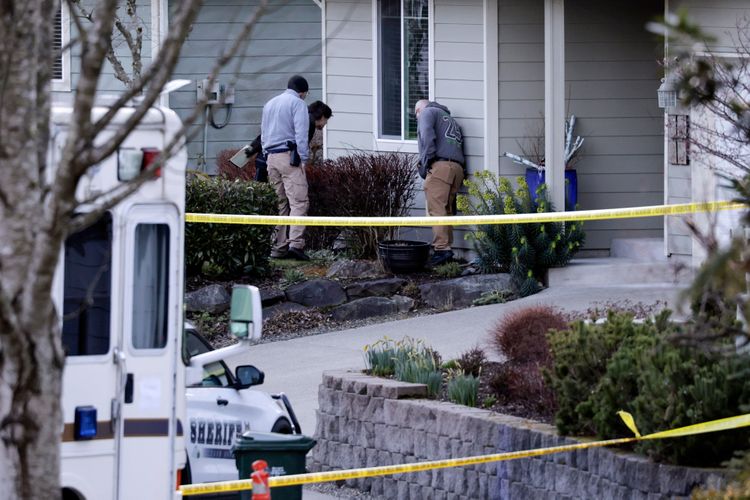
On a calm winter morning near Gig Harbor, Washington, a routine police call quickly turned into a tragedy that has left a community struggling to understand how events unfolded so fast.
Authorities say four people were fatally stabbed outside a home on Feb. 24, in an incident that began with officers responding to what appeared to be a violation of a court-issued protection order. By the time police arrived, the situation had escalated beyond prevention.
The suspect, later identified as Aleksandr Shablykin, was shot and killed by law enforcement at the scene.
A Call That Changed Course
According to the Pierce County Sheriff’s Office, deputies were initially dispatched around 8:41 a.m. after receiving reports that a no-contact order may have been violated at a residence near Gig Harbor.
Officers soon discovered the protective order was not yet legally enforceable because it had not been formally served to the individual involved — a procedural step required before the order takes effect.
Deputies were on their way to serve the paperwork when emergency calls reported an active stabbing outside the home.
Related News

Three victims were pronounced dead at the scene. A fourth person, transported to a hospital by ambulance, later died from injuries.
Police said deputies shot and killed the suspect during the response.
Warnings in Court Records
Months earlier, court documents show that the suspect’s mother, Zoya Shablykin, had sought legal protection from her son.
In May 2025, she was granted a one-year protective order after alleging threats, emotional abuse, and increasingly troubling behavior. In filings, she described herself as an elderly disabled woman and claimed her son’s conduct had become unpredictable and frightening.



Her petition alleged damage to property, harm to her pet, and behavior she believed reflected serious mental distress. She also claimed he threatened her life.
The order required him to remain at least 1,000 feet away from her and barred him from possessing weapons. It also mandated participation in a mental health treatment plan.
But because the order had not yet been formally delivered to him, authorities say it could not legally be enforced at the time police were first called.
A Community in Shock
Neighbors described the area as quiet and close-knit — the kind of neighborhood where serious crime feels unimaginable.
One resident told local media the violence was deeply unsettling, especially because it involved a family relationship. For many, the tragedy disrupted a sense of safety often taken for granted in suburban communities.
In places known for calm routines — morning walks, school runs, familiar faces — sudden violence can feel especially disorienting.
Why the Case Is Drawing Attention
Beyond the immediate loss of life, the incident has renewed discussion about how protection orders function in practice.
Protective orders are designed to create distance and safety, but they typically only become enforceable after being officially served. That gap — sometimes lasting hours or days — can leave vulnerable people in a legal gray area.
The case also highlights ongoing challenges surrounding mental health intervention, particularly when families seek help but systems move slower than escalating personal crises.
Experts often note that domestic conflicts involving untreated mental health concerns can become unpredictable, placing both families and responders in difficult situations.
The Human Weight Behind Legal Procedures
For residents near Gig Harbor, the tragedy is no longer about legal technicalities or timelines. It is about lives lost in a place where neighbors once felt insulated from such violence.
Stories like this resonate because they unfold in ordinary settings — homes, families, familiar streets — reminding people how fragile safety can feel when warning signs and systems fail to align in time.
In the aftermath, a community is left grieving, and many are quietly asking the same question: what could have been different if help had arrived just a little sooner?