






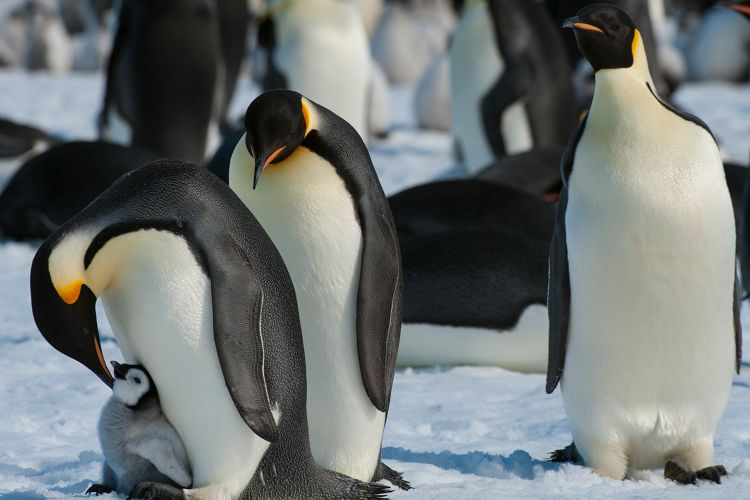
In the vast white silence of Antarctica, emperor penguins have long thrived in one of the harshest environments on Earth.
But the icy world they depend on is changing quickly. And scientists say the consequences are becoming impossible to ignore.
This week, the International Union for Conservation of Nature (IUCN) officially reclassified the emperor penguin as an endangered species, raising its risk level on the organization’s global Red List of Threatened Species.
A Habitat That Is Disappearing
The shift comes as Antarctic sea ice — the frozen platform where emperor penguins live, breed, and raise their young — has dropped to record lows since 2016.
Sea ice may look like a simple frozen surface, but for emperor penguins it functions as a nursery, shelter, and resting ground.
Without stable ice, their entire life cycle becomes fragile.
Related News

Penguin colonies rely on solid ice to safely incubate eggs and raise chicks through the long Antarctic winter. When the ice breaks up too early, the consequences can be devastating.
A Growing Number of Chick Deaths
Researchers have documented a troubling pattern in recent years.
At several breeding sites, melting ice has collapsed beneath penguin colonies before chicks were old enough to survive in the water.
Young chicks do not yet have waterproof feathers. When the ice disappears beneath them, many drown.



Scientists describe these events as mass chick mortality, with entire groups of young penguins lost when breeding platforms break apart.
Even adult penguins face risks. During their annual molting period, they rely on stable ice as a safe place to shed and regrow their feathers. Without it, they are forced into dangerous conditions.
Some manage to escape the water initially, only to later freeze in the severe cold.
A Population at Risk
The IUCN now estimates that emperor penguin populations could decline by about half by the 2080s if current climate trends continue.
Dr. Philip Trathan of the IUCN’s Penguin Specialist Group said the research points to a clear cause.
“Human-induced climate change poses the most significant threat to emperor penguins,” he said, noting that early sea-ice breakup is already disrupting breeding colonies across Antarctica.
Another Antarctic Species in Trouble
The Red List update also included a change for another Antarctic resident.
The Antarctic fur seal, once hunted close to extinction during the 18th and 19th centuries, has now been moved from “Least Concern” to Endangered.
The shift reflects changes in the Southern Ocean food chain.
Fur seals depend heavily on krill, tiny shrimp-like creatures that thrive in cold waters beneath sea ice. But warming oceans and shrinking ice cover are pushing krill populations deeper into the ocean, making them harder for seals to reach.
A Warning From Scientists
For conservation scientists, these updates are more than classification changes on a list.
Dr. Grethel Aguilar, director general of the IUCN, described the findings as a clear signal about the pace of environmental change.
The declining fortunes of emperor penguins and fur seals, she said, highlight how warming oceans and disappearing ice are reshaping entire ecosystems.
Emperor penguins hold a unique place in the public imagination.
From documentaries to children’s books, their image — small groups of birds huddled together against fierce Antarctic winds — has become a symbol of resilience.
But their story is also a reminder that even the most remote corners of the planet are deeply connected to global climate patterns.
The ice beneath their feet is changing, quietly but quickly.
And in that distant landscape of wind and snow, scientists say the shifts are becoming harder to overlook.