





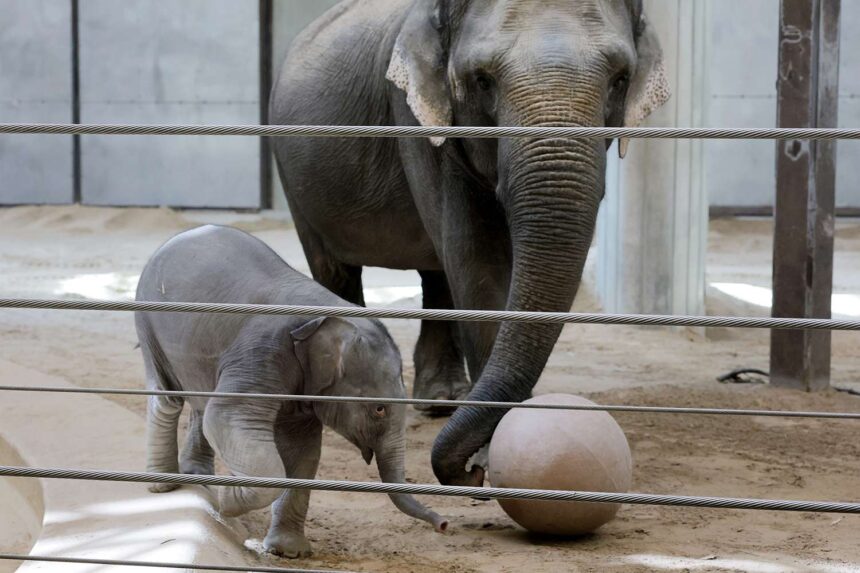
For visitors returning to Smithsonian’s National Zoo this spring, there’s a new arrival waiting—small by elephant standards, but already drawing quiet attention.
Linh Mai, an Asian elephant calf born on February 2, marks the zoo’s first elephant birth in nearly a quarter century. Her arrival is significant, but her first weeks have been anything but straightforward.
What’s unfolding now is a story of careful human intervention, unexpected companionship, and a slow, hopeful start.
A Difficult First Chapter
Linh Mai entered the world weighing 308 pounds, born to her mother, Nhi Linh. Soon after, however, the calf was rejected—something that can occasionally happen in elephant herds, though it poses immediate risks for a newborn.
Related News
From that moment, her care shifted almost entirely to zookeepers.
They stepped in with round-the-clock attention, feeding her by bottle every two hours and monitoring her closely. It’s a demanding routine, one that requires both precision and patience, especially in the earliest weeks of life.

An Unexpected Caregiver
Help came from an older elephant named Swarna.
Though she has never had a calf of her own, Swarna has taken on a nurturing role—staying close, offering guidance, and providing something closer to social comfort than human care alone can replicate.
Keepers are also working to gradually rebuild a connection between Linh Mai and her birth mother, though that process is slow and uncertain.
Growing, Exploring, Becoming
Despite the rocky start, Linh Mai is developing well.



She has already gained more than 100 pounds and is beginning to show a lively personality—playful, curious, and eager to explore. Recently, she’s been introduced to outdoor spaces, taking early steps into a wider world.
Her public debut is planned for April 22, aligning with Earth Day. The timing is intentional.
A Wider Story About Survival
Linh Mai’s arrival comes at a time when wild elephant populations are under pressure.
According to the World Wide Fund for Nature, fewer than 50,000 elephants remain worldwide. Conservation efforts, both in the wild and in managed care, have become increasingly important to maintaining the species.
Zoo officials say Linh Mai could also contribute to improving genetic diversity among captive elephants in North America—a long-term goal that extends beyond a single birth.
Echoes Beyond One Zoo
Her story has also sparked comparisons online to another young animal far from Washington.
Earlier this year, a monkey named Punch at Ichikawa City Zoo gained attention after being rejected by his mother and struggling to integrate with other monkeys.
Over time, Punch began to find his place—a reminder that early setbacks don’t always define what comes next.
Why It Resonates
Stories like Linh Mai’s tend to linger because they sit at the intersection of care and uncertainty.
There’s the technical side—feeding schedules, health checks, conservation goals. But there’s also something more familiar: the idea of being supported when things don’t begin as expected.
In a controlled environment like a zoo, that support can make all the difference.
A Quiet Step Forward
For now, Linh Mai’s world is still small—measured in careful routines, watchful eyes, and tentative connections.
But with each passing day, she’s growing into it.
And for those who come to see her, she may represent something simple but steady: a life given a second chance, and the quiet work it takes to help it continue.