





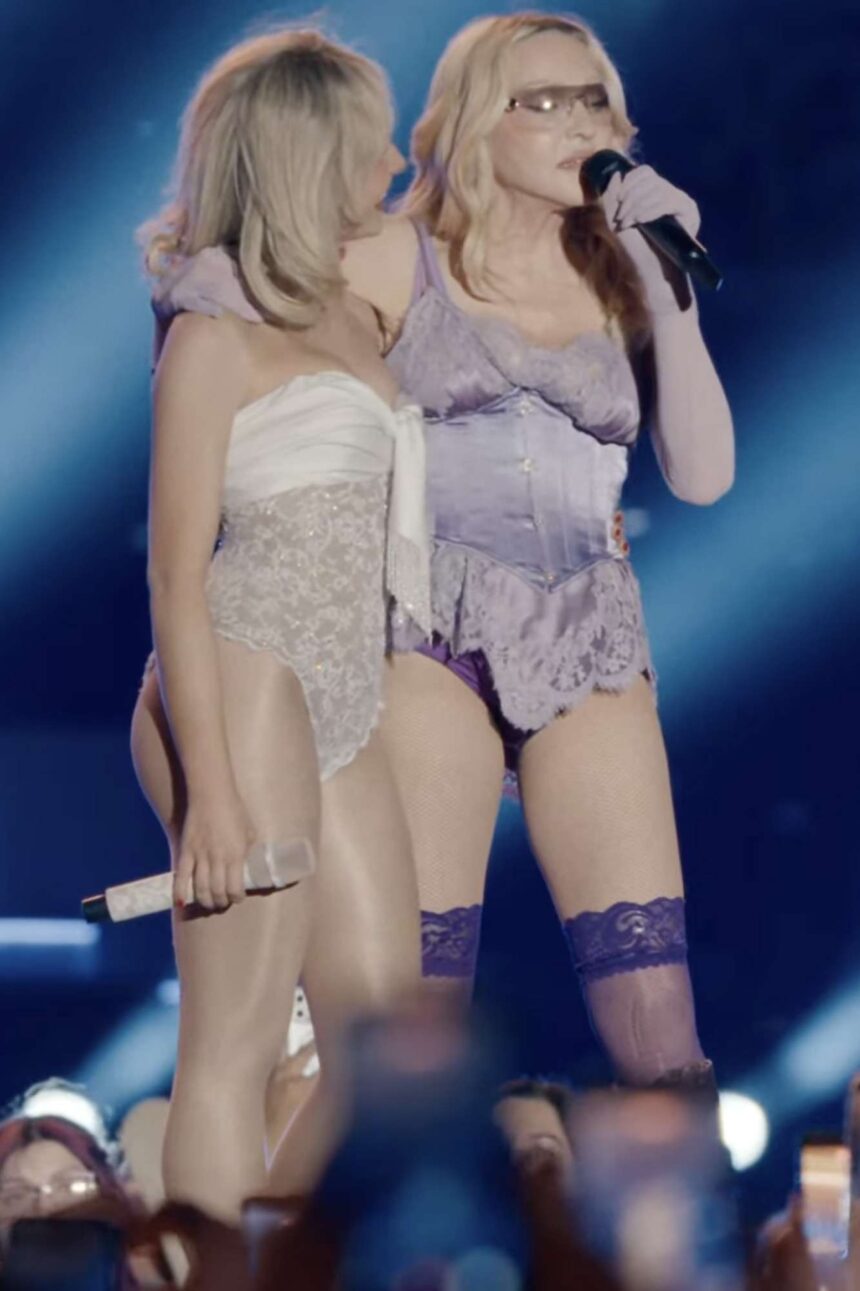
There are moments at music festivals that feel bigger than the setlist — the kind that ripple beyond the desert air and into pop culture memory. On April 17, one of those moments arrived when Madonna stepped onto the stage during Sabrina Carpenter’s headlining performance at Coachella.
For fans, it was unexpected and quietly powerful. A veteran who helped define modern pop standing alongside an artist shaping its next chapter.
Carpenter was mid-set when Madonna appeared, rising from beneath the stage as the crowd processed what was happening in real time. What followed felt both celebratory and intimate — a shared performance that nodded to the past while hinting at what’s ahead.
A Meeting of Eras on Stage
Together, the two performed Madonna classics “Vogue” and “Like a Prayer,” songs that have long outlived their original release moments.
Related News
They also introduced something new — an unreleased track believed to be part of Madonna’s upcoming album Confessions II. The project, set for release on July 3, revisits the sound and spirit of her 2005 album Confessions on a Dancefloor, a record that helped define an era of club-driven pop.
For Madonna, the setting carried personal weight. She told the crowd it had been 20 years since her first Coachella performance, describing this return as a “full circle” moment. Her last appearance at the festival came in 2015, during a set by Drake.

Sabrina Carpenter’s Expanding Stage
For Carpenter, the night reinforced how quickly her career is evolving.
Now 26, she has stepped into a new level of visibility, not just as a performer but as a curator of moments. Her Coachella shows have been filled with unexpected appearances — from Sam Elliott narrating an opening film to cameos by Will Ferrell, Samuel L. Jackson, Susan Sarandon, Terry Crews, and Geena Davis.
The collaboration with Madonna didn’t come out of nowhere. Carpenter had already signaled her admiration, most notably by wearing a vintage gown once worn by Madonna at the 1991 Oscars to the 2024 MTV Video Music Awards.
Moments like this suggest something more than fandom — a kind of artistic lineage playing out in real time.


A Complicated Festival Week
The performance also arrived after a more uneasy moment earlier in Carpenter’s Coachella run.
During her April 10 set, she misinterpreted a fan’s celebratory “Zaghrouta” — a traditional vocal expression of joy — and responded with confusion on stage. The moment circulated widely online, prompting criticism.
Carpenter later addressed it directly, apologizing and acknowledging she hadn’t understood the cultural significance at the time. It was a small but telling reminder of how global audiences bring different meanings into shared spaces like festivals.
Why This Moment Lands
At its core, the duet worked because it felt unforced.
Madonna didn’t arrive as a nostalgia act, and Carpenter didn’t shrink beside her. Instead, the performance showed how pop music evolves — not by replacing what came before, but by building on it.
For audiences, especially those who have grown up with different eras of music, it was a rare alignment. A reminder that influence isn’t abstract; it’s visible, audible, and sometimes standing right next to you on stage.
A Quiet Full-Circle
As the set moved on, the moment lingered.
Not because it was flashy, but because it carried a sense of continuity — of time folding in on itself for a few minutes under stage lights.
For Madonna, it was a return. For Carpenter, it was a step forward. For everyone watching, it was something in between.