






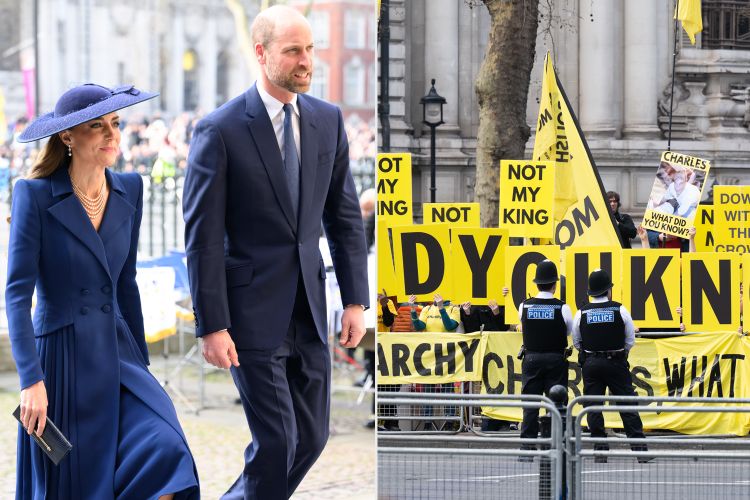
The British royal family gathered in London on Monday for the annual Commonwealth Day service — a moment that typically celebrates unity across nations.
This year, however, the atmosphere felt noticeably different.
As King Charles, Prince William, and Catherine, Princess of Wales arrived at Westminster Abbey, they were met by a line of protesters holding bright yellow signs. The demonstration came just weeks after the arrest of Prince Andrew, casting a long shadow over what is usually one of the monarchy’s most public ceremonial events.
A Royal Gathering Under Scrutiny
The March 9 service marked the largest public appearance by senior royals since Andrew’s arrest on Feb. 19.
Outside Westminster Abbey, members of the anti-monarchy campaign group Republic held signs reading “What did you know?” — a pointed reference to Andrew’s past connections to convicted sex offender Jeffrey Epstein.
Other placards criticized the monarchy more broadly, reflecting renewed public debate about the institution and the accountability of its members.
Related News

Inside the historic abbey, the service proceeded as planned. But beyond the ceremony’s pageantry, the questions surrounding Andrew remained impossible to ignore.
The Arrest That Shook the Palace
Andrew, 66, was arrested early on the morning of Feb. 19 at Wood Farm, a residence on the Sandringham estate in Norfolk.
Police officers arrived shortly after 8 a.m., taking the king’s younger brother into custody and driving him away in an unmarked vehicle.
He was transported to Aylsham police station, where he was questioned for about 11 hours before being released under investigation. No bail conditions were imposed.



The arrest marked a moment without modern precedent: the first time a member of the British royal family had been arrested since 1649, when King Charles I was ultimately executed for high treason.
A Family Trying to Create Distance
The royal household moved quickly to signal separation from the scandal.
In a brief public statement, King Charles said he had learned of the situation “with the deepest concern” and emphasized that the legal process must be allowed to proceed.
Observers noted that the wording appeared carefully chosen — a way to acknowledge the situation while reinforcing that the matter now sits with investigators.
Andrew had already been stripped of his princely title and ordered to vacate Royal Lodge, his longtime residence, in October 2025 amid scrutiny over his links to Epstein.
The Wider Ripple Effect
The arrest has also affected those closest to him.
Sarah Ferguson, Andrew’s former wife, reportedly traveled abroad as renewed attention focused on her past associations with Epstein.
Their daughters, Princess Beatrice and Princess Eugenie, have kept a relatively low profile since the arrest. Both have young families, and people close to them say their priority has been shielding their children from the intense public attention.
Meanwhile, investigators are examining documents released by the U.S. Department of Justice that reportedly suggest Andrew may have shared information with Epstein during his time serving as the United Kingdom’s trade envoy.
What Comes Next
For now, Andrew remains under investigation, with prosecutors still deciding whether charges will be filed.
If charges are brought and a conviction follows, the offense of misconduct in public office carries the possibility of a life sentence under British law.
The case has also sparked discussion within government circles. Lawmakers are reportedly considering legislation that could remove Andrew from the line of succession, where he currently stands eighth.
A Moment of Reflection for the Monarchy
For the royal family, the situation presents a delicate balancing act: continuing public duties while a deeply personal crisis unfolds within the institution.
Events like the Commonwealth Day service are meant to highlight continuity, tradition, and national identity.
Yet the protests outside Westminster Abbey offered a reminder that, in moments like this, public trust — like tradition — is constantly being tested.
And for many watching, the questions raised by Andrew’s case are not only about one man’s actions, but about how modern institutions respond when those at their center face scrutiny.