



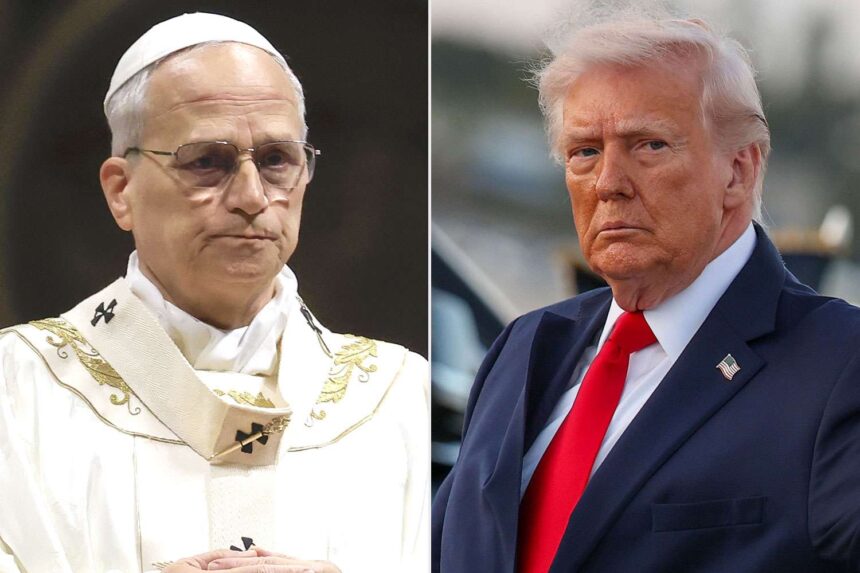
A Rare Rift: Pope Leo Stands Firm After Trump’s Public Rebuke
It’s not often that a pope and a U.S. president find themselves in a public back-and-forth.
But over the past few days, that’s exactly what unfolded between Donald Trump and Pope Leo XIV—a clash that blends politics, faith, and the fragile tone of global diplomacy.
The exchange began with a late-night social media post. It continued, quietly but firmly, at 30,000 feet—on a papal flight headed to Africa.
A sharp critique, delivered online
On Sunday, April 12, Trump posted a lengthy message on Truth Social, criticizing the pope in unusually direct terms.
He described Leo as “weak on crime” and “terrible for foreign policy,” taking aim at the pontiff’s views on global conflicts and U.S. actions abroad.
The president’s frustration centered on the pope’s stance against war—particularly his opposition to the U.S.-linked conflict involving Iran, and criticism of American actions in places like Venezuela.
Related News

Trump also questioned the pope’s leadership and even suggested that his own presidency had influenced Leo’s rise to the papacy.
In a more personal aside, he said he preferred the pope’s brother, describing him as politically aligned with his movement.
A calm response in the air
The following day, speaking to reporters aboard a flight to Algeria, Pope Leo responded—but without matching the tone.
He said plainly that he has “no fear” of the Trump administration and intends to continue speaking out on issues he believes matter.


The pope emphasized that his role is not political. His words, he explained, are rooted in the Gospel—not aimed at individuals.
Rather than engage in a direct argument, Leo drew a boundary. He made clear he does not want a public debate with the president.
A deeper disagreement
At the heart of the tension is a wider divide.
Pope Leo has consistently called for an end to war, urging dialogue and cooperation between nations. He has warned about the human cost of conflict and the dangers of escalating violence.
Trump, meanwhile, has defended a more forceful approach to foreign policy and has pushed back against criticism of U.S. actions.
This isn’t just a disagreement over policy—it’s a contrast in worldview. One framed around diplomacy and moral authority, the other around national strength and political mandate.
Why this moment stands out
Public clashes between a sitting U.S. president and the leader of the Catholic Church are rare.
Even when disagreements exist, they are typically handled through quieter diplomatic channels. This exchange, by contrast, played out in real time—and in full view of millions.
For many observers, that visibility is part of what makes the moment feel different.
The human angle
Beyond politics, the story touches something more personal for many people—especially those who see faith as separate from political conflict.
The pope’s message centers on peace, suffering, and moral responsibility. The president’s message reflects frustration with criticism and a defense of leadership decisions.
For everyday readers, the tension raises a simple but enduring question:
What happens when moral voices and political power speak past each other instead of together?
A quiet refusal to escalate
In the end, Pope Leo’s response was notable for what it didn’t include.
No insults. No counterattacks. Just a steady insistence on continuing his mission.
As the plane carried him toward Africa, the dispute seemed to remain behind—still unresolved, but deliberately unamplified.