





When a young princess became queen in early 1952, the world was changing quickly. Television was still new to many homes, and Britain was adjusting to life after the Second World War.
Then, on a summer morning in 1953, millions of people gathered around flickering screens and radios to watch history unfold as Queen Elizabeth II was formally crowned.
The ceremony would become one of the defining royal moments of the 20th century — both a deeply traditional ritual and a powerful sign of a modernizing monarchy.
A Queen at 25
Elizabeth Alexandra Mary Windsor became queen on Feb. 6, 1952, after the sudden death of her father, King George VI.
She was just 25.
Although she immediately assumed the throne, her coronation did not happen until June 2, 1953. The delay allowed time for extensive planning and for the nation to mourn the late king.
Related News

The ceremony took place at Westminster Abbey, a historic church that has hosted British coronations for centuries.
A Moment Shared by Millions
The coronation quickly became one of the most widely viewed events of its time.
About 27 million people watched on television across the United Kingdom — a remarkable number considering how few households owned a TV at the time. Many families crowded into neighbors’ homes or local shops just to see the broadcast.
Another 11 million listened on the radio, while roughly 8,000 guests attended the ceremony in person inside the abbey.



Outside, three million people lined London’s streets, hoping to catch a glimpse of their new monarch.
The young queen traveled through the city in a golden horse-drawn carriage, an image that quickly became one of the most memorable symbols of the day.
Prince Philip’s Behind-the-Scenes Role
While the world watched the spectacle, much of the organization happened behind closed doors.
Elizabeth’s husband, Prince Philip, played a key role in planning the event. He chaired the Coronation Committee, helping oversee the many logistical details required for a ceremony steeped in centuries of tradition.
From guest lists to ceremonial arrangements, the preparations took months of coordination.
A Dress Designed With Meaning
The Queen also took a personal interest in what she would wear.
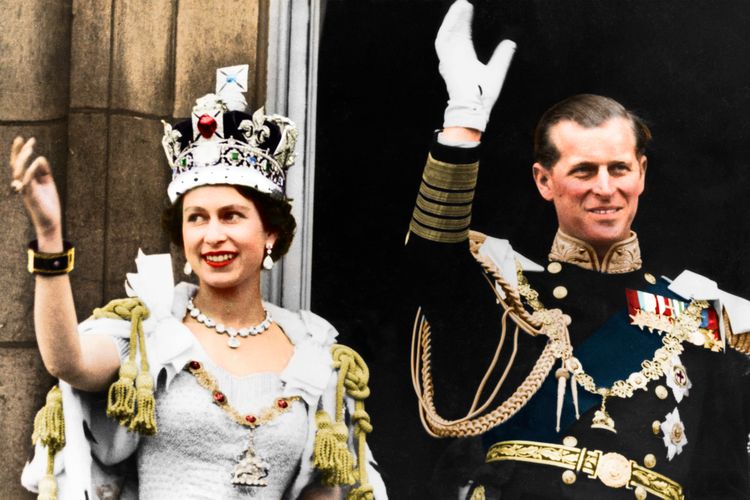
Her coronation gown was created by British designer Norman Hartnell, who had previously designed her wedding dress.
Made from white duchess satin, the gown featured delicate embroidered symbols representing the United Kingdom and countries across the Commonwealth, including Australia, New Zealand and Pakistan.
The details were carefully chosen. Flowers and national emblems were stitched into the fabric, and a small four-leaf shamrock was hidden in the skirt for good luck.
Even the shoes carried symbolic touches. Designed by Roger Vivier and produced with Delman, the gold heels were decorated with rubies and inspired by the architecture of Chartres Cathedral.
The Crowns and Symbols of Power
The ceremony itself was rich with tradition.
At the moment of crowning, the Queen wore St. Edward’s Crown, a heavy and ornate crown used only during coronations.
When leaving the abbey, she switched to the lighter Imperial State Crown, which is commonly worn at major state occasions.
Other historic objects from the Crown Jewels — including the Sovereign’s Sceptre with Cross, the Sovereign’s Orb and the Coronation Spoon — were also used during the ceremony.
Together, these items symbolize the responsibilities, authority and traditions tied to the British monarchy.
A Historic Reign Begins
The coronation marked the formal beginning of Queen Elizabeth II’s reign, which would eventually become the longest in British history.
Nearly seven decades later, the same location hosted another historic moment.
On May 6, 2023, Elizabeth’s son King Charles III was crowned at Westminster Abbey, alongside Queen Camilla.
Just months earlier, the abbey had also held the funeral of Queen Elizabeth II, bringing the story of her remarkable reign full circle.
Why the Coronation Still Matters
The 1953 coronation was more than a royal ceremony. It was a cultural moment that connected millions of people through a new medium — television.
For many families, it was the first major event they watched together on screen.
In a sense, the ceremony helped transform the monarchy into something both ancient and modern — rooted in centuries of tradition, yet suddenly visible in living rooms around the world.