



For decades, the White House Correspondents’ Dinner has been one of Washington’s most familiar rituals — an evening where journalists, lawmakers, and public figures gather in the same room, if only briefly, away from the sharp edges of politics.
On Saturday night, that tradition was shattered by gunfire.
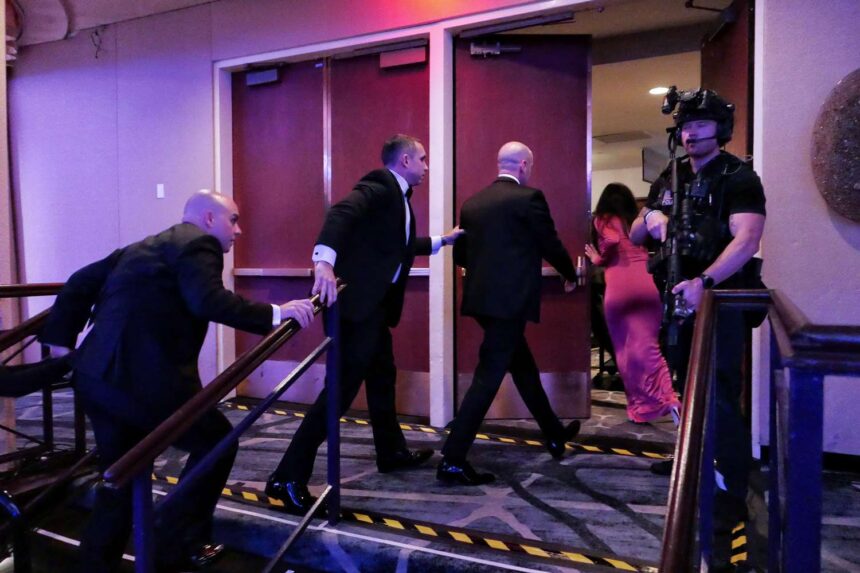
What began as a formal dinner inside the Washington Hilton quickly turned into a scene of confusion and panic, as guests dropped beneath tables and security agents moved swiftly to evacuate senior officials, including Donald Trump, after shots were fired near a security checkpoint.
Seconds That Changed the Room
Witnesses described a sudden, jarring shift in atmosphere shortly after 8:30 p.m. local time.
Moments earlier, guests had been settling in for dinner, conversations flowing in the usual easy rhythm of a major social and political event. Then came the sound of gunfire.
People scrambled for cover.
Related News

Some hid beneath tables. Others froze in place, trying to understand what was happening. Around them, members of the United States Secret Service reacted instantly, surrounding the president and escorting him from the ballroom, alongside Melania Trump, JD Vance, and other senior officials.
Trump was unharmed.
But one Secret Service agent was struck at close range. According to the president, the officer survived because of his bullet-resistant vest and is expected to recover.
A Rapid Response Prevented Something Worse
Authorities say a suspect, identified as Cole Tomas Allen, allegedly approached a security checkpoint carrying multiple weapons before being stopped by Secret Service personnel.


Federal prosecutors, including Jeanine Pirro, said Allen is expected to face charges that include using a firearm during a crime of violence and assaulting a federal officer with a dangerous weapon. Investigators later searched a property believed to be connected to him.
Officials have described the incident as isolated, but investigations into motive and planning are still unfolding.
Security Questions Return — Loudly
In the hours after the shooting, Trump pointed to the incident as proof that presidential security needs another major rethink.
He renewed support for a proposed $400 million White House ballroom project — a venue he says would include heightened protections such as reinforced glass and stronger anti-drone defenses.
Whether that proposal gains momentum remains to be seen.
But the broader debate — how to protect public spaces without sealing leaders off entirely — is now back at the center of national conversation.
Why This Moment Resonates
There is something deeply unsettling about violence breaking into a room built around ceremony.
The White House Correspondents’ Dinner is not only a political event. It is also a rare public reminder that democracy often happens in shared spaces — where reporters question power, leaders face scrutiny, and institutions meet face to face.
Saturday night was a reminder of how fragile that normalcy can be.
And of the quiet reality carried by security officers whose work is most visible only in moments when everything goes wrong.
As Washington wakes to another morning of questions, one image may linger longest: a ballroom full of powerful people suddenly ducking for safety — reminded, like everyone else, just how quickly ordinary moments can turn.