






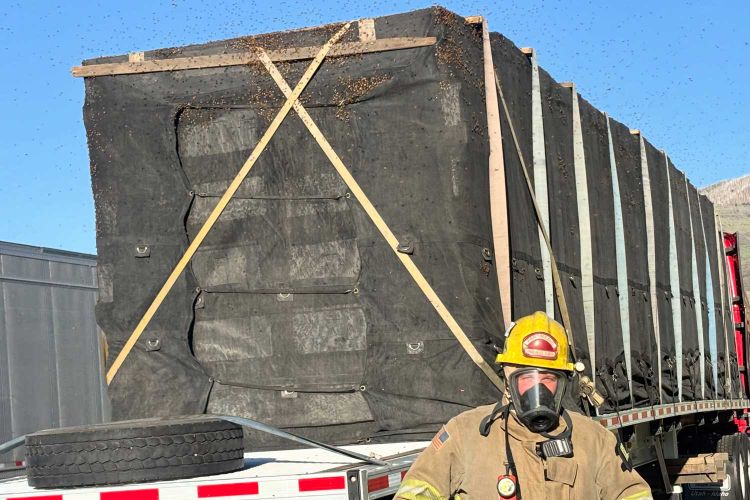
Drivers passing through Parley’s Canyon in Utah earlier this month likely expected traffic delays or roadside repairs. What they probably did not expect was a rescue effort involving millions of honey bees.
On May 12, a semi-truck carrying 480 commercial bee hives broke down during unusually hot weather, leaving the insects trapped inside a stationary trailer under the afternoon sun. Without the cooling airflow that normally comes from highway movement, the bees quickly faced a dangerous situation.
That’s when firefighters stepped in — not for a fire, but for a far quieter emergency.
A Different Kind of Rescue
The Millcreek Fire Department responded after concerns grew that the bees could overheat and die before the truck could be repaired.
While mechanics worked on the disabled vehicle, firefighters carefully sprayed a fine mist of water over the trailer. The goal was simple: lower the temperature enough to keep the hives stable until the truck could get moving again.
Officials later said the approach worked. No firefighters were stung during the operation, despite the sheer scale of the cargo.
Related News

And the scale was remarkable.
Each hive reportedly held as many as 60,000 bees, meaning tens of millions of insects were potentially at risk inside the trailer.
Why the Bees Matter
For many people, bees are background creatures of spring and summer — something noticed in gardens or around flowering trees. But commercially transported honey bees play a major role in modern agriculture.
Large-scale farming operations across North America rely on managed bee colonies to pollinate crops including almonds, berries, apples, and vegetables. During pollination seasons, trucks carrying hives regularly travel long distances between farms and states.



That movement, however, comes with challenges.
Honey bees are highly sensitive to temperature changes, and even short periods of overheating can damage or destroy colonies. In transit, airflow from a moving truck helps regulate hive temperatures naturally. A breakdown in hot weather removes that protection almost instantly.
The Utah incident became a reminder of how delicate that balance can be.
Not the First Bee Emergency in Utah
The rescue also echoed another unusual bee-related emergency in the state just a few years earlier.
In June 2022, a truck transporting more than 200 hives overturned on Interstate 80, scattering bees across the highway and forcing temporary road closures. Cleanup crews reportedly spent several hours trying to recover the hives and contain the insects safely.
Two people, including the truck driver, suffered minor injuries in that incident, some from bee stings. Authorities later said speeding may have played a role in the crash.
Compared with that scene, this month’s breakdown ended far more quietly — though no less urgently for the bees involved.
A Story People Connected With
The fire department later described the rescue as one of those moments that highlights the unpredictable nature of emergency work.
Firefighters are often associated with house fires, car accidents, or medical calls. But increasingly, departments also respond to environmental emergencies, animal rescues, and climate-related situations that would have seemed unusual years ago.
Online, many people reacted warmly to the idea of firefighters protecting bees rather than avoiding them. Others pointed to the growing public awareness around pollinators and their importance to food systems.
The image of crews standing beside a truck, gently misting millions of overheated bees under the Utah sun, struck many readers as oddly calming — a reminder that emergency response is sometimes about preserving small, fragile things as much as saving human lives.
And in this case, keeping a trailer cool for a few extra hours may have protected millions of tiny workers most people never even see.