






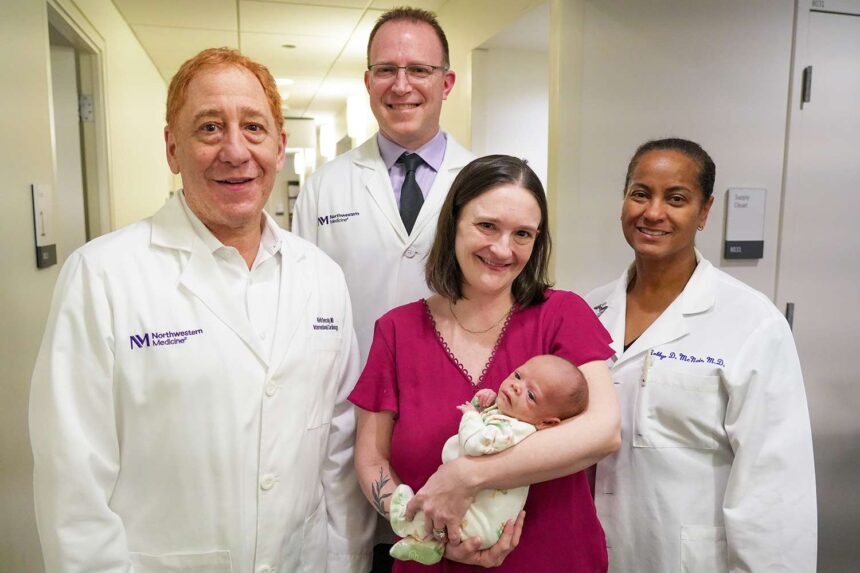
For Chelsea Cheveria, the day she welcomed her second daughter was meant to be simple, planned, and joyful.
A scheduled cesarean section at Northwestern Medicine on February 10 brought baby Zairah Cheveria safely into the world — a healthy little girl weighing 5 pounds, 2 ounces. Her husband, Scott Cheveria, was by her side, celebrating the moment many families dream about: mother healthy, baby safe, everything going according to plan.
Then, in less than an hour, everything changed.
Chelsea suddenly became unresponsive on the operating table. What had been a routine delivery turned into a life-threatening emergency, leaving doctors scrambling to understand what was happening — and her family facing the unimaginable possibility that she might not survive.
When Minutes Mean Everything
Medical teams moved quickly.
Doctors performed four rounds of CPR. Chelsea was placed on a ventilator. Specialists prepared ECMO, an advanced form of heart-lung life support used in the most critical cases. Every decision became a race against time.
Related News

It was Keith Benzuly, an interventional cardiologist, who identified the cause: a massive pulmonary embolism — two large blood clots lodged in Chelsea’s lungs, blocking blood flow to her heart.
Though uncommon, pulmonary embolisms can be deadly within minutes if left untreated.
Doctors administered blood thinners and carried out an emergency pulmonary thrombectomy, a delicate procedure used to physically remove dangerous clots from the lungs. It saved her life.
Waking Up to a Different Reality
Chelsea opened her eyes the following day in intensive care.


The room around her was filled with machines, alarms, and the weight of what she had survived. Her body carried the cost of emergency intervention — broken ribs and a fractured sternum from chest compressions that kept her alive.
But one question mattered more than anything else: Was her baby okay?
She learned that little Zairah was healthy and waiting in the nursery.
That knowledge, more than medicine alone, became part of her healing.
Soon after, Chelsea was able to hold her newborn daughter — a quiet, deeply human moment after extraordinary trauma. For families who have walked through medical crises, those first touches can feel less like routine bonding and more like reclaiming life itself.
A Reminder Hidden Inside Routine
Childbirth in wealthy countries is often viewed as predictable, managed, and medically safe — and in most cases, it is.
But Chelsea’s story is a reminder that even routine deliveries can carry sudden and severe risks.
Pulmonary embolism during or after pregnancy is rare, but pregnancy itself raises the likelihood of blood clot formation because the body naturally shifts into a more clot-prone state to reduce bleeding during childbirth. In rare cases, that protective change becomes dangerous.
The difference between tragedy and survival often comes down to speed: recognizing symptoms, immediate intervention, and access to advanced emergency care.
Chelsea had all three.
Finding Normal Again
Today, Chelsea is home in Chicago with Scott, baby Zairah, and the couple’s older daughter, 4-year-old Annayiah Cheveria.
Recovery is still unfolding — physically and emotionally.
But amid the pain, there is also gratitude, perspective, and an unexpected openness to the future. Chelsea has said that if doctors believe it can be done safely, she would consider another pregnancy.
That thought may seem surprising after such trauma.
Then again, parenthood has always involved holding love and fear in the same hands.
And sometimes, simply making it home becomes the part of the story a family never forgets.